
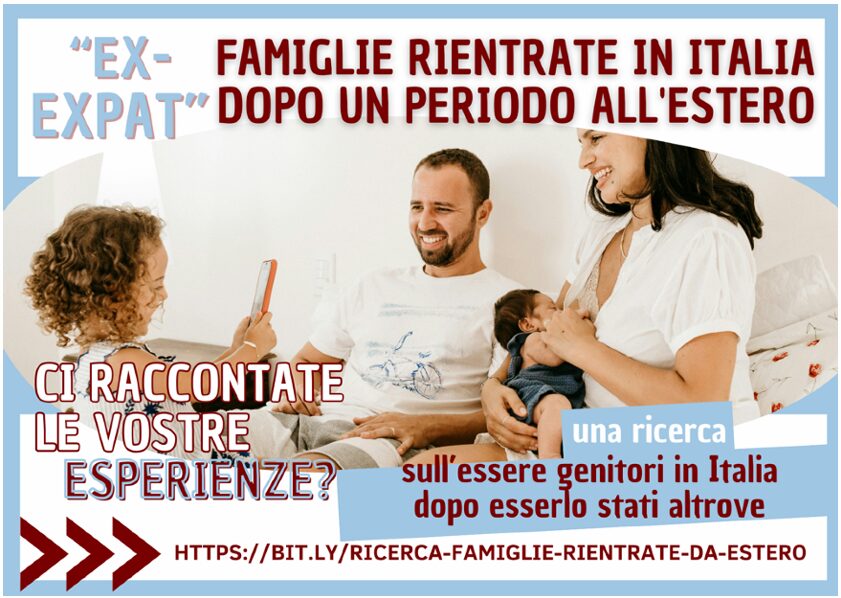
Fondazione Migrantes launches a study on families who returned to Italy after living abroad. Take part.
[ENG]
A new research project aims to give voice and attention to “former expats” — and in particular to former expat parents: mothers and fathers who chose to move back to Italy with their children after a period living abroad.
Why did they return? How do they compare the support and services families receive abroad with those available in Italy? Are they satisfied with reconnecting with their families of origin? How much did Italy’s tax incentives for returning talent (“rientro dei cervelli”) impacted on their decision?
After portraying Italian families around the world in the book “Crescere Expat,” based on the largest study ever conducted on Italian parents abroad, journalist Eleonora Voltolina — with the support of Fondazione Migrantes — now turns her attention to those who chose to come back.
Data collection for this new research is currently underway. You can access the form here:
https://bit.ly/ricerca-famiglie-rientrate-da-estero
The questionnaire will remain online until 31 July: the set of questions allows participants to share — anonymously, of course — information, curiosities, and reflections on their experience as former expat parents who chose to move back to Italy with their children.
Are you happy to be back? Would you do it again? What did you rediscover in Italy that you didn’t have abroad? And what do you miss?
The only requirements to take part in this research are having at least one child under 25, and having returned to live in Italy after living abroad with your family.
The main goal of the research is to build a comparison between the experience of parenting in Italy and abroad, exploring not only the practical aspects but also the emotional ones that emerge as significant for parents returning to Italy.
For this reason, the study does not include people who did not have children while abroad (and had them only after returning to Italy), nor people who returned to Italy without their children (i.e., when their children were already adults and did not follow them back).
For everyone else we can’t wait to collect your stories and points of view.